
NEWS-SUN // Andy Brosig
Driving in a rural area just over the state line in Texas, you'll find a tiny green house sitting in the middle of cotton fields.
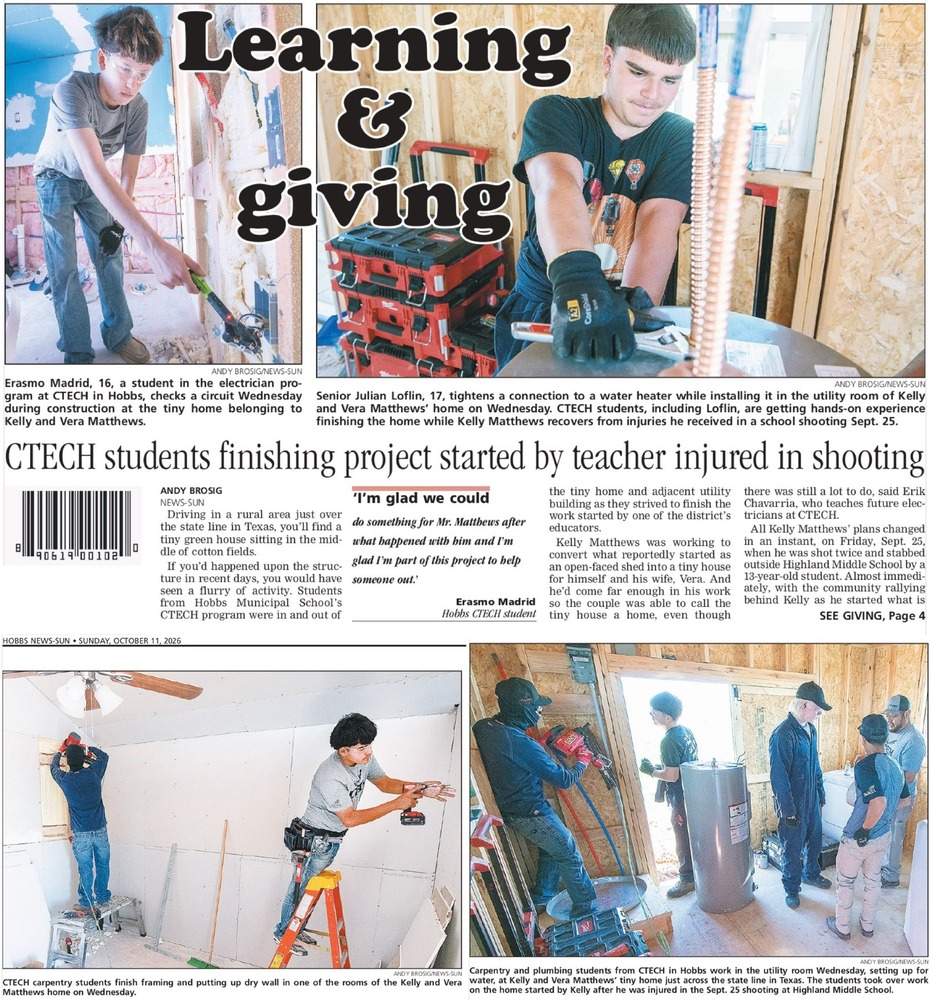
If you'd happened upon the structure in recent days, you would have seen a flurry of activity. Students from Hobbs Municipal School's CTECH program were in and out of the tiny home and adjacent utility building as they strived to finish the work started by one of the district's educators.
Kelly Matthews was working to convert what reportedly started as an open-faced shed into a tiny house for himself and his wife. Vera. And he'd come far enough in his work so the couple was able to call the tiny house a home, even though there was still a lot to do, said Erik Chavarria, who teaches future electricians at CTECH.
All Kelly Matthews' plans changed in an instant, on Friday, Sept. 25, when he was shot twice and stabbed outside Highland Middle School by a 13-year-old student. Almost immediately, with the community rallying behind Kelly as he started what is sure to be a long process of recovery, Hobbs Municipal School officials who knew of the work he was doing to build his home, stepped up with a plan.
Gene Strickland, superintendent of schools for HMS, and Jose Mares, who's in charge of Career and Technical Education for the district and director of the CTECH campus, approached the instructors with a project they hoped the students and instructors could take on.
The task presented to Chavarria and his fellow instructors in the CTECH carpentry and plumbing programs?
To finish the work Kelly Matthews started, converting that former shed into a home.
The answer they all came up with was simple, direct and to the point, Chavarria said.
"We said, ‘Sure.'"
The first step was for Chavarria, plumbing instructor Joe Ochoa and carpentry instructor Oscar Contreras to do a walk-through of the project to see what they were facing and to make sure the work done up to that point was done correctly. They didn't find any problems, Ochoa said, despite Kelly's inexperience in the construction trades.
Training future electricians, carpenters and plumbers at CTECH typically takes place in a laboratory setting, with mock-ups of walls, breaker boxes and plumbing runs for students to practice on. Getting out in the field, working on an actual home with all the vagaries and potential conflicts — wiring needs to run through walls, but so do drain pipes, things like that, Chavarria said — takes the teaching to a new level.
Working in the lab setting "is more of a controlled environment," Ochoa said.
Real-world experience
One of the things professionals have to make sure of is everything they do meets local, state and federal building codes on the jobsite, he said. And, while they stress the same attention to detail in the lab, doing it in the real world adds an extra level.
"This is more in-depth into code to actually get plumbing running, the safety of it, the correct services,” Ochoa said. "This is installation (of service) and new construction all in one project, so the thing they understand now is the phases and stages" of a project.
"They learn that in the lab also," he said. "But to actually come and do it, it's better for them to get the understanding of it. They actually get to put it to use in the real world."
They're learning, for example, how contractors work and how the different trades have to balance and work with each other, Ochoa said. They're also learning to communicate with the other trades, as well as simple things, including how to handle tools properly and safely on the job site.
Electrical student Erasmo Madrid, 16, said the experience of real life versus the lab makes all the difference.
"This is obviously different than in the lab," Madrid, a junior at Hobbs High School, said. "But it's still going to help us.
"Every day, every time I get into a project, it teaches me something I don't know," he said. "I'm actually getting a full experience on how to do something in a house."
At one point, for example, Madrid and another student were struggling to wire a plug in the bathroom of the tiny home, usually a fairly straightforward process. But the pair had to troubleshoot why, even though it was wired correctly, their circuit tester refused to beep when it was plugged into the outlet, meaning there was no power.
Once they figured that out - an issue in the breaker box on the other side of the building - they weren't done. Just as the professionals do at a job site, with more plugs to wire and check, it was on to the next project.
And, while Madrid was fighting recalcitrant wiring in the main house, fellow student Julian Loflin was with a group of Ochoa's advanced plumbing students in a utility building across a small deck to the east, working to bring water to the home.
After digging trenches and running supply lines to the building, one student crawled under the building while Loflin led the plastic pipe up and secured it to a wall. Then, after adding fittings to hook the lines into the system, he and Ochoa muscled a new water heater into place in the corner, ready to supply Kelly and Vera with hot water when the time comes.
Before advancing to Hobbs High School and the CTECH program, Loflin, a 17-year-old senior this year, attended Highland. And, while he knew of Kelly Matthews, he didn't really know him personally, he said.
But that didn't matter, Lotlin said. When Ochoa asked for volunteers to help with the tiny house project for Kelly and Vera, he didn't hesitate.
"I thought it was really amazing, because something like (the shooting) that happens is very tragic," Loflin said. "It feels good to help someone like that."
Ochoa agreed: "Yeah, they were excited. They were on board the minute I asked them.
Satisfaction
Wednesday was the students' second day on the job. And when Loflin got home Tuesday night after a full first day, he said he was tired and ready for bed. But, the next morning, he woke up ready and willing to head back out to the project house and do it all over again.
"It means a lot" to be able to help Kelly and Vera, Loflin said. While he hates the circumstance that made their efforts necessary, he said "being able to help — we're happy to do this."
Madrid agreed. There wasn't any hesitation to step up and help from any of them when their teachers asked.
"We said, 'Yeah, let's do this,'" Madrid said. “I'm glad we could do something for Mr. Matthews after what happened with him and I'm glad I'm part of this project to help someone out."
And, while they're learning practical lessons that will help them as they advance in their careers in the future, the students are also learning less-concrete lessons about being a member of a community.
"There's more to it, there's more to be proud of than just the job," Chavarria said. "It's teaching them construction work isn't just about construction."
Ochoa agreed: "They're learning about service to the community, about being good people, about helping out when they can."
Those lessons will put them in good standing with whatever community they end up in, he said. Some of the students have already said they want to own their own company one day. The experiences they're getting this week are teaching them it's not all about the money - sometimes it's about being good community members, Ochoa said.
"It's all about good karma,” Chavarria said. "Good karma comes back around."